Author: Olaitan

  • NIGERIA new petroleum Price

    NIGERIA new petroleum Price

    In this post I will like to explain what are the NIGERIA New petroleum Price and what are the reason for increasing in Price

    NIGERIA new petroleum Price

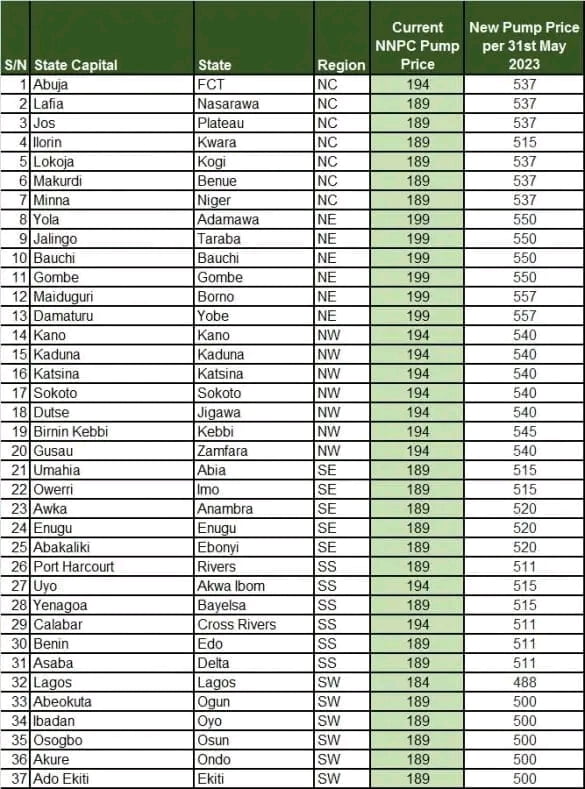
    Since the federal government has removed fuel subsidy nnpc has changed the Price of each one of every state

    On 30 May 2023 nnpc change the fuel price because of removal of fuel subsidy by new Nigeria president bola Ahmed tinubu

    You can Also read

    NIGERIA minister allocation and salary allowance

    These are the new price of Nigeria petroleum Price

    1 NASARAWA State Old Price is per liter 198 and new price per liter is 537

    2 FCT Abuja old price per liter is 198 and new price is 198 and per liter is 537

    3 Plateau State old Price per liter is 198 and new price per liter is 537

    4 Kwara state old price per liter is 198 and new price per liter is 515

    5 Kogi State old Price per liter is 198 and new price per liter is 537

    6 BENUE state old price per liter is 198 and new price per liter is 537

    7 Niger State old Price per liter is 198 and new price per liter is 537

    8 Adamawa State old Price per liter is 199 and new price per liter is 550

    9 Taraba State Old Price per liter is 199 and new price per liter is 550

    10 BAUCHI STATE Old Price per liter is 199 and new price per liter is 550

    11 Gombe State Old Price per liter is 199 and new price per liter is 550

    12 BORNO state Old Price per liter is 199 and new price per liter is 557

    13 Yobe State Old Price per liter is 199 and new price per liter is 557

    14 Kano State Old Price per liter is 194 and new price per liter is 554

    15 Kaduna State Old Price per liter is 194 and new price per liter is 554

    16 Katsina State Old Price per liter is 194 and new price per liter is 554

    17 Sokoto State Old Price per liter is 194 and new price per liter is 554

    18 Jigawa State Old Price per liter is 194 and new price per liter is 554

    19 Kebbi State Old Price per liter is 194 and new price per liter is 545

    20 Zamfara State Old Price per liter is 194 and new price per liter is 550

    21 Abia State Old Price per liter is 189 and new price per liter is 515

    22 Imo State Old Price per liter is 189 and new price per liter is 515

    23 Anambra State Old Price per liter is 189 and new price per liter is 520

    24 Enugu state Old Price per liter is 189 and new price per liter is 520

    25 Ebonyi State Old Price per liter is 189 and new price per liter is 520

    26 Rivers State Old Price per liter is 189 and new price per liter is 511

    27 Akwa Ibom State Old Price per liter is 189 and new price per liter is 511

    28 Bayelsa State Old Price per liter is 189 and new price per liter is 511

    29 Cross Rivers State Old Price per liter is 189 and new price per liter is 511

    30 Edo State Old Price per liter is 189 and new price per liter is 511

    31 Lagos State Old Price per liter is 184 and new price per liter is 488

    32 OGUN State Old Price per liter is 189 and new price per liter is 500

    33 OYO State Old Price per liter is 189 and new price per liter is 500

    34 DELTA State Old Price per liter is 189 and new price per liter is 511

    35 OSUN State Old Price per liter is 189 and new price per liter is 500

    36 ONDO State Old Price per liter is 189 and new price per liter is 500

    37 Ekiti State Old Price per liter is 189 and new price per liter is 500

    Lagos state was the state that has the lowest price rate among the others state

  • NIGERIA Federal ministry of petroleum resources

    NIGERIA Federal ministry of petroleum resources

    In this post I Will like to explain who are the Ministry of Petroleum Resources in Nigeria

    What are the duties of Federal ministry of Petroleum resources in Nigeria and their functions

    Federal ministry of Petroleum resources

    Federal Ministry of Petroleum Resources (FMPR) is a part of the Federal Ministries of Nigeria that directs petroleum resources and its activities in Nigeria.

    History of federal ministry of petroleum resources (fmrp)

    In the beginning, Petroleum matters were handled by the Hydrocarbon Section of the Ministry of Affairs in Lagos which reported directly to the Governor general.

    Petroleum resources Unit delivered responsibilities such as: keeping records on exploration matters,importation of petroleum products, enforcing safety and other regulations on matters which were then mostly products importation and distribution, etc.

    Petroleum resources Unit was upgraded to a Petroleum Division within the Ministry of Mines and Power, with the expansion of the petroleum industry activities.

    In 1971,Nigerian National Oil Corporation (NNOC) was created to handle direct commercial operational activities in the oil industry on behalf of the Nigeria Federal Government.However, the Department of Petroleum Resources in the Federal Ministry of Mines and Power continued to exercise statutory supervision and control of the industry. In 1975, the department was upgraded to a ministry named (Ministry of Petroleum and Energy) which was later renamed the Ministry of Petroleum Resources. Ministry of Petroleum Resources was re-established 1985


    Organizational structure of ministry of petroleum resources

    The Ministry of Petroleum Resources is a organization control by government whose operational framework is made up of the Minister who is a political appointee, the Permanent Secretary who is the career officer and the Chief Accounting Officer of the Ministry.

    The Permanent Secretary reports all the affairs of the Ministry to the Minister, while the Directors in the Ministry report to the Permanent Secretary.

    Director of petroleum resources

    Ministry has 12 Directorates, each headed by a Director they are

    1 Department of Human Resources Management

    2 Department of Planning, Research and Statistics

    3 Department of Press and public relations

    4 Department of Finance and Accounts

    5 Legal Department

    6 Department of Procurement

    7 Department of Gas

    8 Department of oil services

    9 reforms Co-ord,

    10 General services

    11 internal audit

    12 Department of Special Duties

    Each of these Departments has various divisions and sections in a hierarchical and pyramid setting headed by deputy directors, and the assistant directors heading sub-sections and units.

    Directors report directly to the Permanent Secretary, while the deputy directors report to the Directors and the assistant directors report to the deputy directors respectively. Ministry of Petroleum Resources operational frame work operates in a hierarchical level from the top management cadre down to the middle and junior executive cadre.

    Role duty and power of Nigeria ministers

    Departments of ministry of petroleum resources

    1 Permanent of Secretary

    2 Director of Human Resources Management

    3 Director of Finance and Accounts

    4 Director of Planning Research and Statistics

    5 Director of Legal Services

    6 Director of Gas

    7 Director of Oil Services

    8 Director of Special Duties (Overseeing Midstream)

    9 Deputy Director of Reforms Co-Ord.

    10 Deputy Director of General Services

    11 Deputy Director of Internal Audit

    12 Deputy Director of Press and Public Relations

    13 Director of Procurement

    14 Deputy Director of overseeing Downstream

    15 Deputy Director of Federal Audit

    Departments division and function of ministry of petroleum

    1 Human Resources Management

    Division of human resources management

    There are 2 division under human resources management

    1 Appointment, Promotion and Discipline (APD).

    2 Staff Welfare and Training (SWT)

    Functions

    Is headed by a Director of Appointment, promotion, discipline, planning, development, supervision, evaluation and welfare activities

    Finance and Accounts

    Division

    There are 3 division of finance and account

    1.Budget

    2. Recurrent

    3. Capital

    Functions

    Three deputy directors and their respective assistant directors

    Responsible for the financial transaction of the Ministry.

    Planning, Research and Statistics

    Division

    Research and Statistic

    Functions

    Is Headed by a Director

    Is Formulation and implementation of policies, conduct research studies, etc.

    Legal services

    Functions

    Headed by a Director and assisted by six assistant legal officers (ALAs)

    Handles all legal issues involving the Ministry of Petroleum Resources and its Agencies.

    Gas Resources

    Division

    1. Gathering and Infrastructure (G&I)

    2. Strategy and Policy (S&P)

    3. Pricing and Open Access (P&)

    Functions

    Is Headed by a Director, three deputy directors, three assistant Directors and a Chief officer Regulate the gas sector, in accordance with the National Gas Master Plan and other National Policies.

    5 Oil Services

    Division

    1.Upstream

    2.Midstream

    3. Downstream

    Functions

    Is Headed by a Director

    Co-ordination, Monitoring of Policies, Programmes, and evaluation of projects in the oil industry.

    7 General Services

    Division

    1. General Services

    2. Maintenance

    Functions

    Headed by a Director and two deputy Directors.

    Responsible for general services such as Transport Administration, Utility Services, and other Special Assignments.

    8 Press and Public Relations

    Functions

    by a Director.

    Serves as the information gateway between the Ministry and its public.

    9 Procurement

    Division

    1. Capital

    2. Recurrent

    Functions

    Headed by a Director and two assistant Directors

    responsible for the procurement of goods, works and services to the Ministry

    duties of ministers of petroleum

    To Ensure an enabling environment to improve the Oil and Gas value chain,best practices, industry, driven by modern technology, stakeholders’ engagement and innovations in alternative energy

    responsibilities of minister of petroleum

    Is To deliver a thriving Oil and Gas (Energy) Industry for country (Nigeria)

    Functions of minister of petroleum resources

    Policy matters relating to research and development in Petroleum and Gas sectors of the Petroleum industry

    Initiation and formulation of the board policies and programmes on the development of the Petroleum sector (Oil and Gas) in general;

    All policies matters on the marketing of crude oil, natural gas, Petroleum products and their derivatives;

    All concession policies in the oil and gas sub-sectors of the energy sector of the economy;

    Development of hydro-carbon industries including natural gas, processing, refineries and Petrochemical industries through public private partnership

    Licensing of all Petroleum and gas operations and activities

    Formulation of policies to ensure increase of natural oil and gas reserve base and Nigeria’s increased technical productivity in accordance with appropriate planning and allocation of production quotas to producing companies in line with OPEC quota and maximization of revenue from oil and gas to the Nation

    Formulation of policies to stimulate private industry investment and participation in the oil and gas sectors

    Coordination and supervision of all bilateral and multilateral relations affecting the energy (Oil and Gas) Sector; Overall supervision and coordination of the activities of the following parastatals and its subsidiaries

    Administration of government joint venture interests in the Petroleum sector in order to maximize fully economic benefits derivable from Nigeria’s oil and gas resources and ensuring optimization of government interest in all oil and gas arrangements

    Agencies under petroleum resources

    Nigeria National Petroleum Corporation (NNPC)

    Department of Petroleum Resources (DPR)

    Petroleum Technology Development Fund (PTDF)

    Petroleum Equalization Fund (PEF)

    Petroleum Training Institute (PTI)

    Petroleum Products Pricing Regulatory Agency (PPPRA)

    Parastatals of ministry of petroleum resources

    1 Nigeria National Petroleum Corporation

    2 Department of Petroleum Resources

    3 Petroleum Training Institute

    4 Nigeria Nuclear Regulatory Authority

    5 Petroleum Products Pricing Regulatory Agency Archived 27 November 2021 at the Wayback Machine

    6 Nigerian Content Development Monitoring Board

    7 Petroleum Technology Development Fund

    8 Petroleum Equalisation Fund

  • Federal Ministry of Communications and Digital Economy

    Federal Ministry of Communications and Digital Economy

    In this post I will like to explain who are the Federal Ministry of Communications and Digital Economy (FMCDE)

    What are the rule and regulations that guild FMCDE

    Nigeria Federal Ministry of Communications and Digital Economy

    Nigeria Federal Ministry of Communications and Digital Economy (FMCDE) is a Ministry created in 2011 as the Ministry of Communication Technology

    FMCDE was created to foster a knowledge based on economy and information society in country (Nigeria). Ministry was created to facilitate information communication technology ( ICT) as a key tool in the transformation agenda for Nigeria in the areas of job creation, economic growth and transparency of governance.

    Responsibilities of FMCDE

    FMCDE responsibility is to create a robust digital economy that enhances security, increases transparency, and diversifies the Nigerian economy.”

    Role of FMCDE

    Federal ministry of communications and digital economy is leverage Digital Technologies for National Economic Development.”

    Nigeria federal ministry of aviation

    Authority and power of federal ministry of communications technology

    FMCDE is Assigned to the Ministry of Communications and Digital Economy by the Federal Government of Nigeria, the Ministry has four key authority

    – To Facilitate universal, ubiquitous and cost effective access to communications infrastructure throughout the country (Nigeria)

    – To Utilize ICT to drive transparency in governance and improve the quality and cost effectiveness of public service delivery in country (Nigeria).

    – To Promote the utilization of information communication technology (ICT) in all spheres of life to optimize the communications infrastructure – digital content creation, domestic software applications and the delivery of private and public services over the internet.

    – To Promote and facilitate the development of the information communication technology ICT industry and increase the contribution of the ICT industry to GDP.

    Departmental under the federal ministry of communications and digital economy

    There are 12 department under the federal ministry of communication. There are

    1 information communication technology (ICT)

    2 E- Government

    3 Human resources management (HRM)

    4 Planning Research statistics (PRS)

    5 Telecommunications and postal service (TPS)

    6 Finance and account

    7 Spectrum management

    8 Procurement

    9 National frequency management council (NFMC)

    10 Radio monitoring and survey

    11 General service

    Unit department under the FMCDE

    There are 5 unit under federal ministry of communication and digital economy

    Anti corruption and transparency unit

    Internal audit Unit

    Legal unit

    Press and public relations unit

    Servicom

    Agencies of the FMCDE

    List of agencies under FMCDE. There are 6 agencies under the federal ministry of communication technology they are

    Infrastructure

    Digital Nigeria

    E- Government initiative

    Local content and capacity

    Digital girls

    Fmoc social media retreat

    NCCDC

    Leadership and Directors of FMCDE

    List of Leadership and Directors of FMCDE. They are

    1 Honourable Minister

    2 Permanent Secretary

    3 Director, HRM

    4 Director, PRS

    5 Director, General Services

    6 Director, ICT

    7 Director, National Frequency Management Council

    8 Director, Legal

    9 Director, Reforms Coordination & Service Improvement

    10 Director, e-Government

    11 Director, Procurement

    12 Director, Spectrum Management

    13 Ag. Director, Telecoms & Postal Services

    14 Ag. Director, Radio Monitoring & Survey

  • Nigeria federal ministry of aviation

    Nigeria federal ministry of aviation

    In this post I will like to explain what are the Federal Ministry of Aviation in Nigeria (FMA)

    In this is You will know the role , Duties and responsibilities of federal ministry of aviation FMA

    NIGERIA Federal ministry of aviation

    The ministry is responsible for formulation and management of the government’s aviation policies in Nigeria

    Federal ministry of aviation is acronym of FMA

    Federal ministry of aviation is directly responsible for overseeing air transportation, airport development and maintenance, provision of aviation infrastructural services and other needs Ministry is headed by a Minister appointed by the President of a State and assisted by a Permanent Secretary, who is a career civil servant.

    Ministry is also responsible for parastatals such as the Nigerian College of Aviation Technology

    History of Departments under the federal ministry of aviation

    Previously the ministry’s Civil Aviation Department investigated aircraft accidents. In 1989 the Federal Civil Aviation Authority (FCAA) opened, and the Civil Aviation Department became the FCAA Department of Safety Services. During that same year the Accident Investigation Bureau (AIB), subordinate to the Ministry of Aviation, was established and the FCAA no longer had accident investigation responsibilities. The name of the bureau was later changed to the Accident Investigation and Prevention Bureau. As part of the Civil Aviation Act of 2006 the AIB became an autonomous agency, the Accident Investigation Bureau

    Duties of FMA

    The Federal Ministry of Aviation is one of the Federal Ministries of Nigeria that regulates aviation services and air travels in Nigeria the Federal Ministry of Aviation is formulate, update and implement the National Aviation Master Plan for the overall development of the aviation industry in the Nigeria

    FMA is also to collect, store, analyze, and disseminate meteorological data to end users install, maintain and upgrade equipment and infrastructure on timely basis and at all airports. To set and implement safety and security measures in the sector in line with the International Civil Aviation Organization (ICAO) standards, the World Meteorological Organization (WMO) requirements and recommended best practices for the enhancement of safety oversights. FMA Ministry’s also extends to airports development and management, the provision of aviation security, and the improvement of airspace management.


    Responsibilities of federal ministry of aviation

    The federal ministry of aviation FMA responsible for the safe of the people, secured and efficient Aviation Industry focused on making Nigeria a hub that meets international standards and best practices for the African continent

    Role duty and power of Nigeria ministers

    Past chairman of aviation ministries

    List of Past and present minister of aviation FMA From 1960 to date

    Dr. K.O Mbadiwe 1960-1961

    Hon. Raymond Njoku 1962-1965

    Chief J. A Nwachukwu 1965-1966

    Chief J. S Tarka 1967-1971

    Dr. R.A.B Dikko 1971-1975

    Maj. Gen. Shehu Musa Yar’ Adua (NA) 1975-1976

    Navy Capt. Olumide (NAF) 1976-1976

    Alhaji S. Kazaure 1976-1978

    Alhaji Shehu Wunti 1978-1979

    Hon. Sam Mafuyayi 1979-1982

    Hon. J.J Kadiya 1982-1983

    Ahaji Ibrahim Abdullahi 1984-1984

    Rear Admiral Patrick Koshoni (NN) 1984-1985

    Maj. Gen. Jeremiah Oseni (NA) 1985-1987

    AVM Anthony Okpere (NAF) 1987-1989

    Alhaji Bunu Sheriff Musa 1989-1990

    Alabo Tonye Graham Douglas 1990-1992

    Engr. Olawale Ige 1992-1992

    Chief Oluwole Adeosun 1993-1993

    Alhaji Bashiru Dalhatu 1993-1993

    Alhaji Aremu Yahaya 1993-1994

    Chief Ebenezer Babatope 1994-1995

    Air Cmdr. Nsikak Eduok (NAF) 1995-1996

    Air Cmdr. Ita Udo-Imeh (NAF) 1996-1998

    Capt. Benomi Briggs 1998-1999

    Dr. Olusegun Agugu 1999-2000

    Dr. (Mrs) Kema Nonyerem Chikwe 2000-2003

    Malam Isa Yuguda 2003-2005

    Prof. Babalola Borishade 2005-2006

    Chief Olufemi Fani-Kayode 2006-2006

    Felix Hassan Hyat 2007-2008

    Babatunde Omotoba 2008-2010

    Mrs. Fidelia Akuabata Njeze 2010-2011

    Princess Stella Adaeze Oduah-Ogiemwonyi (OON) 2011-2014

    Dr. Samuel Ioraer Ortom 2014-2014

    Osita Benjamin Chidoka 2014-2015

    Senator Hadi Sirika July 2015 June 2019 and also Appointed Substantive Minister of Aviation from August 2019 to date

    Past permanent secretary of aviation

    List of permanent secretary of aviation from 1988 to date

    Alfa Wali 1988-1990

    Gidado Idris 1990-1994

    Makama. D (Unfound) 1994-1996

    Kaigama F. (Unfound) 1996-1998

    Nwokedi S. Un 1998-1999

    Ajulo S. B. 1999-2000

    R. U. Audu 2000-2002

    P. O. Okunromade 2002-2003

    T. D. Oyelade 2003-2005

    S. D. Kassim (MNI) 2005-2007

    Mrs. A. Lawan 2007-2009

    Idris S.A. Kuta 2009-2010

    Kifasi. D.I. 2010-2010

    A.N. Ene-IT (Mrs) 2010-2012

    George A. Ossi 2013-2014

    Dr, Jamila Shu’ara (FNIM) 2014-2014

    S.K. Yemi Adelakun 2014-2014

    Mohammed Abbas 2014-2015

    Binta Adamu Bello (Mrs) 2015-2015

    Zakari Sabiu (Perm Sec. for the two merged Ministries Transportation & Aviation) 2015-2019

    Engr. Hassan Musa 2019-2021

    Abel Olumuyiwa Enitan 2021-2022

    Dr. Emmanuel C. Meribole 2022 to Date

    Agencies under the federal ministry of aviation

    Federal airport authority of Nigeria (FAAN)

    Nigeria airspace management agency (NAMA)

    Nigeria college of aviation technology (NCAT)

    NIGERIA methodological agency (NIMET)

    Accident Investigation Bureau (AIB)

    Departmental and unit under the aviation

    Air Transport management

    Air safety administration

    Aerodromes Development

    Planning Research and Statistics

    General service

    Human resources

    Finance and account

    Procurement

    Internal audit

    Legal unit

    Special duty

    Reformed coordinator and service improvement

  • NIGERIA Federal ministry of agriculture and rural development

    NIGERIA Federal ministry of agriculture and rural development

    In this post I will like to explain who are the federal ministry of agriculture and rural development

    what are the responsibilities of federal ministry of agriculture

    Federal ministry of agriculture and rural development (FMARD

    Federal ministry of agriculture and rural development Is an acronym of FMARD. Federal ministry of agriculture and rural development has the authority to ensure food security in crop in a country, livestock as well as fisheries to stimulate agricultural employment and services to the national and promote the production and supply of raw materials to agro industries and to  provide markets for the production of the industries sectors, generate foreign exchange as well as help rural socio-economic development”

    Responsibilities of  federal ministry of agriculture and rural development FMARD

    The ministry is responsible for various roles involving national goals of rural development, food security, rural income growth and job creation

    The ministry fulfills its responsibilities through its departments and parastatals. It also supervises and provides funding for research institutes such as the National Root Crops Research Institute, National Animal Production Research Institute (NAPRI), National Veterinary Research Institute (NVRI) the Rubber Research Institute of Nigeria (RRIN) and Colleges of Agriculture and Forestry among others. The Rubber Research Institute of Nigeria (RRIN) is situated in IYANOMO VILLAGE, off Benin/Sapele Highway, Benin City, Edo State.

    History of federal ministry of agriculture and rural development FMARD in Nigeria

    Prior to Nigeria’s independence in 1960, the agricultural sector served the as the purpose of growing and exporting cash crop produce to the United Kingdom to support the development of the British industrial revolution era. During the period, agricultural processing was minimal but there was sufficient commodity output for consumption in the domestic economy.

    Federal ministry of agriculture rural development (FMARD) was Created in 1966 and had passed through a serial modification of appellations to suit the prevailing climes of mergers and demergers with related sectors. All the same, the adjustment enabled the Federal Government to play a leading role in promoting agricultural activities in the country

    Power and Authority of federal ministry of agriculture and rural development (FMARD)

    Federal Ministry of Agriculture and Rural Development FMARD) is a Ministry of the Federal Government of Nigeria that has the mandate to ensure food security in crops, livestock and fisheries, stimulate agricultural employment and services promote the production and supply of raw materials to Agro- allied industries, provide markets for the products of the industrial sector, generate foreign exchange and aid rural Socio-economic development throughout Nigeria.

    Duty of FMARD

    Federal ministry of agriculture and rural development (FMARD)  duty is to Organize and manage the agriculture sector and facilitate agribusiness for increased food security and employment along commodity value chains and agro-industrial development to earn foreign exchange and contribute to socio-economic development of the country.

    Role duty and power of Nigeria ministers

    Reason for creating FMARD

    These are the reason why FMARD was Created

    – To Grow county’s agriculture sector

    – To Drive income growth

    – To Accelerate food and nutrition security

    – To Generate employment

    – To Transform county into a leading global food market with wealth for farmers”

    Policies under federal ministry of agriculture FMARD

    This section contains the Policies and legislation for transformation and also Key policies for success by the Federal Ministry of Agriculture and Rural Development.The policies are highlighted below.

    Fiscal Policies

    Domestic Content for Food (Enabling Legislation)

    Industrial Policies

    Financial Service Policies

    Agricultural Policies


     DEPARTMENTS AND AGENCIES UNDER FMRD

    The Ministry is made up of about 7 department agencies. They are

    37 State offices

    17 departments

    6 Regional Offices

    15 research Institutes

    11 Agencies

    14 Colleges of Agriculture and a number of Universities of Agriculture

    15 Institute of college of research under the FMARD

    List of 15 Institute of college of research under the FMARD

    RESEARCH INSTITUTESCOLLEGES OF AGRICULTUREUNIVERSITIES OF AGRICULTURE

    VETERINARY COUNCIL OF NIGERIA, ABUJA

    NIGERIA INSTITUTE OF ANIMAL SCIENCE, ABUJA

    NIGERIA INSTITUTE OF SOIL SCIENCE, ABUJA

    NATIONAL AGRICULTURAL LAND DEVELOPMENT AUTHORITY, ABUJA

    AGRICULTURAL RESEARCH COUNCIL OF NIGERIA, ABUJA

    NATIONAL INSTITUTE FOR FRESH FISHERIES RESEARCH, NEW BUSSA

    NATIONAL AGRICULTURAL EXTENSION RESEARCH LIASION SERVICES, ZARIA

    NATIONAL VETERINARY RESEARCH INSTITUTE, VOM

    NATIONAL INSTITUTE OF OCEANOGRAPHY AND MARINE RESEARCH, LAGOS

    NIGERIAN INSTITUTE FOR OIL PALM RESEARCH, BENIN

    NIGERIAN STORED PRODUCTS RESEARCH INSTITUTES, ILORIN

    LAKE CHAD RESEARCH INSTITUTE, MAIDUGURI

    INSTITUTE OF AGRICULTURAL RESEARCH AND TRAINING, IBADAN

    MAIDUGURI INSTITUTE OF AGRICULTURAL RESEARCH, ZARIA

    RUBBER RESEARCH INSTITUTE OF NIGERIA, BENIN

    List 11 of Agencies under FMARD

    NIGERIA AGRICULTURAL QUARANTINE SERVICE, ABUJA

    BANK OF AGRICULTURE, KADUNA

    AGRICULTURAL AND RURAL MANAGEMENT TRAINING INSTITUTE, ILORIN

    NIGERIAN AGRICULTURAL INSURANCE CORPORATION, ABUJA

    NIGERIA AGRICULTURAL SEED COUNCIL, ABUJA

    NATIONAL CENTRE FOR AGRICULTURAL MECHANIZATION, ILORIN

    NIGERIA INSTITUTE OF ANIMAL SCIENCE, ABUJA

    NIGERIA INSTITUTE OF SOIL SCIENCE, ABUJA

    VETERINARY COUNCIL OF NIGERIA, ABUJA

    NATIONAL AGRICULTURAL LAND DEVELOPMENT AUTHORITY

    AGRICULTURAL RESEARCH COUNCIL OF NIGERIA, ABUJA

    37 STATES under the FMARD

    ABIA

    ADAMAWA

    AKWA IBOM

    ANAMBRA

    BAUCHI

    BAYELSA

    BENUE

    BORNO

    CROSS RIVER

    DELTA

    EBONYI

    ENUGU

    EDO

    EKITI

    GOMBE

    IMO

    JIGAWA

    KADUNA

    KANO

    KATSINA

    KEBBI

    KOGI

    KWARA

    NASARAWA

    NIGER

    OGUN

    ONDO

    OSUN

    OYO

    PLATEAU

    RIVERS

    SOKOTO

    TARABA

    YOBE

    ZAMFARA

    6 regional under the FMARD

    1 NORTH EAST

    2 NORTH WEST

    3.NORTH CENTRAL

    4.SOUTH EAST

    5. SOUTH WEST

    6.SOUTH SOUTH

    14 Colleges of Agriculture and a number of Universities of Agriculture

    FEDERAL COLLEGE OF AGRICULTURE AKURE, ONDO STATE

    FEDERAL COLLEGE OF AGRICULTURE, DADINKOWA, GOMBE STATE

    FEDERAL COLLEGE OF AGRICULTURE, IBADAN, OYO STATE.

    FEDERAL COLLEGE OF AGRICULTURE ISHIAGU, EBONYI STATE

    FEDERAL COLLEGE OF ANIMAL HEALTH AND PRODUCTION TECHNOLOGY, IBADAN, OYO STATE.

    FEDERAL COLLEGE OF ANIMAL HEALTH AND PRODUCTION TECHNOLOGY, VOM, PLATEAU STATE.

    FEDERAL COLLEGE OF FISHERIES AND MARINE TECHNOLOGY, LAGOS

    FEDERAL COLLEGE OF FRESHWATER FISHERIES TECHNOLOGY, BAGA, BORNO STATE

    FEDERAL COLLEGE OF FORESTRY MECHANIZATION, AFAKA, KADUNA STATE

    FEDERAL COLLEGE OF LAND RESOURCES TECHNOLOGY, KURU, JOS, PLATEAU STATE.

    FEDERAL COLLEGE OF LAND RESOURCES TECHNOLOGY, OWERRI IMO STATE.

    FEDERAL COLLEGE OF WILDLIFE MANAGEMENT, NEW BUSSA, NIGER STATE.

    FEDERAL COLLEGE OF FORESTRY, IBADAN, OYO STATE.

    FEDERAL COLLEGE OF FORESTRY, JOS, PLATEAU STATE.

    SAMARU COLLEGE OF AGRICULTURE (DAC), ZARIA KADUNA STATE

    COLLEGE OF AGRICULTURE (DAC), KABBA, KOGI STATE.

    University under the FMARD

    FEDERAL UNIVERSITY OF AGRICULTURE, ABEOKUTA

    UNIVERSITY OF AGRICULTURE, MAKURDI

    MICHAEL OKPARA UNIVERSITY OF AGRICULTURE, UMUDIKE

    Functions federal ministry of agriculture and rural development FMARD

    The mandates of the Departments and Parastatals centre around the Ministry’s general functions of

    To Promoting an efficient and effective credit administration system.

    To Collaborating with development partners on agricultural development initiatives.

    To Mainstreaming gender and youth related agricultural and rural development programmes.

    To Promoting effective linkage between research and farmers through efficient agricultural extension services.

    To Building capacity and vocational skills to impact on agricultural best practices to all stakeholders.

    To Creating a conducive environment to stimulate greater sector participation in agriculture to enable the business side assume it’s appropriate role as the engine of economic growth.

    To Increasing agricultural production through the promotion of supportive and service-oriented sub-sectoral activities to enhance production, productivity and marketing opportunities.

    To Developing the seed industry and technology as the foundation of sustainable practice.

    To Promoting the research and development of appropriate agricultural technology including biotechnology to transform agricultural production and productivity

    To Promoting agro-processing, preservation and storage to reduce pre- and post- harvest losses to the barest minimum.

    To Promoting the timely availability of adequate and quality agro – inputs to enhance production.

    To Developing an efficient competitive and self–sustaining production, health and management of improved livestock species in the country to meet the protein needs of the populace and the raw materials requirements of industries.

    To Intensifying settlement programmes for pastoralists by providing necessary facilities at the grazing reserves and supporting ranching facilities.

    To Developing integrated Pest Control and Management System for sustainable crop and livestock production in the country.

    To Providing virile national animal, fisheries and plant quarantine services.

    To Increasing the level and widening the scope of insurance coverage of agricultural production to reduce risk and losses attendant to agricultural production.

    To Maintaining the Strategic National Food Reserve Programme for purposes of food security and market stability.

    To Coordinating agricultural and rural development data and information management system.

    To Inventorying land resources and controlling land use and degradation, as well as promoting climatic change adaptation and resilience practices.

    To Encouraging agricultural commodities development and marketing institutions.

    To Sustaining the development of the artisanal, industrial and aquaculture fisheries potentials of the country for self-sufficiency in fish production and export.

    To Stimulating the technology of production and processing to take advantage of untapped resources in the fishery sector.

    To Collaborating with States and Local Governments and other stakeholders in the planning, implementation, monitoring and evaluation of agricultural policies, programmes and projects in the country.

    To Mobilizing and empowering the rural communities through increased agricultural, industrial and other non-farm activities for the improvement of livelihoods.

    To Promoting rural health, nutrition and infrastructural development.

    To Organizing and promoting strong cooperative groups in the various sub-sectors.

    To Ensuring the competitiveness of Nigeria’s agricultural products to derive maximum advantage from the provisions of bilateral, regional and multilateral institutions agreements, conventions and treaties without compromising national interest.

  • NIGERIA governors forum NGF

    NIGERIA governors forum NGF

    In this post I will like to explain what are the NIGERIA governors forum NGF is all about

    Who is the current chairman of NGF

    How many past NGF do we have I NIGERIA

    NIGERIA governors forum NGF

    NIGERIA governors forum is abbreviated from NGF the aim and object NIGERIA governors forum is to committed to collaborative development ensuring excellence in governance at sub-national levels and to embraced essential and enduring tenets that guide everyone in the organization

    Changing and developing of the Nigeria Governors’ Forum

    The changing and developing of the NGF can be tied to two phases the first is being from 1999 to 2008 and the second is l being from 2009 till date

    The first phase is characterized by very minimal activity by the Forum as well as a paltry meeting attendance by members and a weak secretariat. The Secretariat then was merely involved in organizing meetings and collecting annual dues, which was used for running the Secretariat

    The second phase started in earnest from 2009, two years after the Dr. Abubakar Bukola Saraki became the Chairman of the Forum. He spearheaded a major restructuring and redefining of the NGF in his tenure ended in 2011 when he handed over to his successor, the then Governor of Rivers State, Rt. Hon. Rotimi Chibuike Amaechi.

    With the new structure, the office of Vice Chairman was created with Mr. Peter Obi, Governor of Anambra State, emerging as the pioneer Vice Chairman. His inspiring leadership style transformed the NGF into a formidable association by reinvigorating the commitment of Governors in pursuing the main thrusts of creating the association. The formation of the NGF was not only expedient but imperative for the States to assert themselves and to collectively influence the nature and course of policies at the national level Given that the state of the polity in the days following the end of many years of military rule,

    there was a clear need for States to re-assert themselves and exercise the level of independence that is the wont of a true federation.

    It had also become necessary for them to regain their past glory of constituting a credible unit within the wider context of the federation, thereby removing the manifest distortion which militates against the realization of true federalism.

    Thus, the NGF began to take a new shape in the form of stronger cohesion and a dramatic increase in the level of commitment. The changing and developing of the Forum from 2009 till date could be attributed to the following milestones:

    increase in attendance at meetings which has gone up significantly from the hitherto 9-12 out of 36 to the present 35-36 out of 36 members. Forum meetings have formed the basis for major policy contributions on important national issues such as the debates on Sovereign Wealth Fund, Minimum Wage, and the removal of fuel subsidy.

    In addition to regular meetings, various working committees (e.g. on security,Constitutional Review, Revenue Allocation, etc.) are functional.

    More broadly, the National Executive Council monthly meetings usually drive the scheduling of Forum meetings and common positions adopted at these meetings form the crux of the Governors priorities at NEC.

    The articulation of a Strategic Plan to guide the Forum’s activities. With the assistance of the DFID, a 3 – year Strategic Plan (2010-2012) was put together.

    This set the tone for the activities of the NGF and provided the direction for its future engagements. It was launched on 8th February 2011 and came to an end in December 2012. Another Strategic Plan for the years from 2014 to 2016 succeeded the first and is the current plan. Plans are at advanced stage to put forward the next strategic plan.

    Achievement of Nigeria governors forum NGF

    These are the Nigeria Governors’ Forum achievement from 1999 to date

    The achievements of the Nigeria Governors’ Forum since inception include but not limited to the following:

    1 Seminar on Fiscal Federalism: NGF in collaboration with the Forum of Federations that is an international agency that promotes federalism and the Federal Ministry of Finance, organized seminars on fiscal federalism in Nigeria the first one took place in 2008 and the second in 2009. The seminars sought to place focus on the economic relationship between the State and federal levels of government, with special emphasis on fiscal federalism.

    2 Excess Crude Funds :Nigeria Governors’ Forum was instrumental in facilitating the release of excess crude funds from Paris Club debts to the States in 2008 the funds have been distributed several times since then to augment the income accruable to States for development purposes.

    3 Doctrine of Necessity: it was the intervention of the Forum that saw to the resolution of the impasse that almost engulfed the country over the recognition of Dr. Goodluck Ebele Jonathan as the Acting President and saved the country from the brink of precipice, during the ailment and absence of Late President Umaru Musa Yar’Adua in 2010

    4 First Ever State Peer Review Mechanism (SPRM) in Sub-Sahara Africa Following the mandate of the National Economic Council (NEC) on the Secretariat to develop a State Peer Review Mechanism (SPRM), the NGF Secretariat (NGFS) embarked on an assessment of developed projects in the States in early 2009 and 2010. This provided an opportunity for the States to showcase their achievements as well as their areas of challenges.

    5 Consequently : NGFS in collaboration with the United kingdom (UK) Department for International Development (DFID) through its State Partnership for Accountability, Responsiveness and Capability (SPARC) programme, developed a comprehensive set of benchmarks and indicators and adopted a systematic and robust Peer Review process.

    With support from DFID and SPARC, the NGFS appointed a Programme coordinator for the SPRM, recruited of pool of experts and trained journalists on the methodologies of the SPRM.

    6 Governors have become more technical on matters of good governance in measurable terms through the instrument of the State Peer group Review Mechanism, which they have continued to leverage on as a platform for peer learning.

    7 Health Interventions polio, Childhood related diseases, etc.

    The Forum has sustained collaborations with the Bill and Melinda Gates Foundation and with the United Nations Children’s Fund (UNICEF) largely with the aim to fast-tracking Nigeria’s attainment of a polio free status, developing ways of combating malnutrition and reducing maternal and child death due to vaccine-preventable diseases that were prevalent in certain parts of the country.

    Specifically, concerned with the increasing spate of the polio epidemic across States, members of the Forum committed to pursue integrated interventions towards eradicating polio by December 2013 instead of the initial 2012 deadline

    The Bill and Melinda Gates Foundation supported ‘Nigeria Governors’ Immunization Leadership Challenge’ was officially commissioned in January 2012 with all 36 Governors and FCT minister signed-up.

    These efforts culminated in the successful interruption of transmission of the wild polio virus and the subsequent de-listing of Nigeria from the list of polio-endemic countries by the World Health Organization in September 2015.

    8 Partnership with National Governors Association of America: NGFS has a strong partnership with the National Governors Association (NGA) Washington DC, the United States equivalent of the NGF.

    9 Governors’ Retreats Cognisant of the challenges of governance that confronted the States in the first decade of the new democratic process, the Forum felt the need for a retreat of all the governors – a concerted arrangement that would herald a new era in the quest for good governance in the States and by extension Nigeria. Deliberations and resolutions from these retreats have been useful in shaping of policies at the sub-national level.

    9 Policy Realignment and Strategic Relationships : NGF promotes strategic alignment between National and State policies and seeks to support states in domesticating policies and developing institutions that will enable their development.

    10 The NGF plays a focal role in coordinating the engagement of all these partners with the States. By shaping stakeholders’ programmes in a way that aligns with and reflects priorities of the States, stakeholders are supported to develop good working relationships, which is crucial to successful delivery of their programmes.

    11 MDAs such as Universal Basic Education Commission (UBEC), Millennium Development Goals (MDGs) office, Education Trust Fund (ETF), Federal Accounts Allocation Committee (FAAC) etc. and Development Partners such as, united Nations International Children’s Education Fund (UNICEF), Bill and Melinda Gates Foundation, George Town Consultancy South Africa, George Town University USA, World Bank, UK Department for International Development (DFID), United Nations Development Programme (UNDP), German International Development Cooperation (GIZ) etc.

    12 Development of the NGF Strategic Plan With the assistance of DFID, the NGFS developed a 3-year Strategic Plan from 2010 to 2012 to guide the Forum’s activities. The Strategic Plan was launched on February 8th, 2011 to build on the successes and lessons learned during the implementation period, a new Plan was developed to cover the period from 2014 to 2016

    Domestication of Fiscal Responsibility and Public Procurement Acts Following the passage of the Fiscal Responsibility and Public Procurement Acts in 2007, the Forum constituted a committee of Attorneys-General of States to examine the bills as a prelude to passing their state equivalent.

    13 As a result of the interest of development partners and other stakeholders in the implementation of this bill, a multilateral MoU was signed between the NGF Secretariat and Africa Development Bank (AFDB), United State Agency for International Development (USAID) World Bank in collaboration with Federal Ministry of Finance and the Debt Management Office (DMO),

    Agency for Development (AFD), EU, Canadian International Development Agency (CIDA), Japanese International Corporation (JICA), UK Department for International Development (DFID),to facilitate cooperation with the States in the implementation of the bill.

    14 Electoral Reforms In response to the burning issues surrounding electoral reforms, NGF constituted a sub-committee to look into these issues and also liaise with the National Assembly to resolve any controversies in the reform. In a bid to entrench a culture of free, fair and transparent elections in the country, members of the Forum also pledged to a free, fair and credible election in the 2011 General Elections.

    15 Induction Programme for Newly Elected and Re-elected Governors In an effort to strengthen the governorship institution, the NGFS in conjunction with the NGA put together an induction programme and symposium for newly elected, re-elected and returning governors in May 2011 in Abuja. Resource persons within and outside the country participated in this event that was designed to prepare governors for better governance.

    16 Working Tour to Germany The NGF in collaboration with the German Agency for International Cooperation (GIZ) organized working tour of six Governors to Germany in August 2012 to understudy the economic development, policies and best practices in the German federation for the purpose of replicating such commendable practices in the various States.

    17 The first Retreat was held in 2007. Subsequently, 3 other retreats have been held in Lagos, Rivers States and sokoto respectively. A major difference between the first retreat and the succeeding one was that rather than have the governors come to Abuja, these retreats were taken to the States, the direct beneficiaries of the retreats.

    18 The NGF Governance Share Fairs The Governance Knowledge share fair is designed to among other things help states benefit from each other’s experience and stimulate interest in future collaboration and the development of new programmes.

    The Governance Share Fair is intended to provide opportunities for State Governments of Nigeria to broadcast their achievements, exhibit their products, facilitate face to face networking and promote State-to-State exchange on common agendas, help people benefit from each other’s experiences and stimulate interest in future collaboration. The first Fair was held for the South East States in Enugu on 24th & 25th of May, 2012 and the second fair was held in Lagos in May 17th and 18th May, 2013.

    19 Publication of the Inaugural Speeches Compendium In furtherance of the mission of the Nigeria Governors’ Forum, which is, among other things, “to promote good governance, sharing of good practice and enhance co-operation at the state level and with other arms of government and society,” the Nigeria Governors’ Forum Secretariat published a compendium of Inaugural Speeches of Presidents (1999 – 2011) and Governors (2007 – 2013) of the Federal Republic of Nigeria, in 2014.

    20 This is the first time this kind of book has ever been published in the history of Nigeria. The Inaugural speeches publication is a reference material for both the elected and the electorate, researchers, academics, students of Nigerian etc. For the governors, it is a constant reminder of the promises to their people and a compass to guide them through the perilous journey that governance is.

    21 To the electorate, on the other hand, these “words on marble” uttered by the governors are veritable instrument for them to hold the governors accountable at the end of their stewardship. Copies have been made available to major libraries both nationally, all Ministries, Departments and Agencies as well as our partners and stakeholder. Furthermore, the NGF has imbibed the culture of collating these speeches to enhance record keeping.

    22 Capacity Building Workshops In a bid to Improve Public Financial Management (PFM) transparency, accountability effectiveness and sustainability at the sub-national level in Nigeria, the NGF Secretariat in collaboration with the World Bank and the UK Department for International Development (DFID) State Partnership for Accountability, Responsiveness and Cooperation (SPARC) organized a two-day Interactive Workshop on Public Financial Management from June 10 -11, 2013.

    23 This was aimed at obtaining broadbased feedback on issues and challenges of PFM reform implementation at the sub-national level of government with a view to possibly provide need-based technical assistance to States. It was also to provide a platform for information and knowledge sharing on good PFM practices for peer learning.

    24 Development of a Content Management Site The Content Management System (CMS) was developed with support from DFID/SPARC. The NGF CMS is a secure website that allows authorized users to store, give access to and communicate important information related to NGF activities. The main goal of the CMS is to equip the NGF with appropriate information management tools and techniques to enable users to be more effective and efficient in addressing organizational goals and needs.

    The CMS aims to facilitate accurate and timely information dissemination and exchange between the NGF and key stakeholders, and increase awareness of NGF objectives and activities.

    25 Strategic Relations with the Legislature (National Assembly Liaison) The Forum has a functional federal liaison unit. The responsibility of the unit is to open up channels of communication with the legislative arm of government in order to proactively track bills and motions for amendments to the Laws of the Federation, with specific attention to those with direct bearing on States.

    26 Internally Generated Revenue (IGR) Conferences In a bid to assist states to boost internally generated revenue (IGR) and reduce the high fiscal dependency on oil revenue, the Nigeria Governors’ Forum has continued to organize dialogues and peer learning events to provide a platform for sharing practical and effective measures that will boost revenue generation in states, and also identify short, medium and long term strategies for improving and sustaining revenue sources.

    27 The 1st National Round-table Strategy Session on Internally Generated Revenue IGR was held, between 16th and 18th of November, 2009, with the objective of building the confidence of taxpayers in the institutions of government since the States are vital instruments for revenue generation diversify IGR to non-oil sources of revenue; and adapt global best practices to IGR administration.

    The 2nd Edition was a 2-day National Peer Learning Event organized with support from DFID-SPARC, FEPAR, SAVI, GEMS3 and the World Bank on the 16th and 17th November 2015 in Abuja.

    28 This event sought practical ways to reduce their dependencies on federal allocations and galvanise efforts to strategically review and reposition financial, technical and human resources to improve internally generated revenues.

    List PAST CHAIRMAN of NGF FROM 1999 TILL DATE

    There are 9 chairmen of Nigeria governors forum from 1999 till 2023

    Alhaji Abdullahi Adamu

    Arc. (Obong) Victor Bassey Attah

    Lucky Nosakhare Igbinedion

    Dr. Abubakar Olubukola Saraki was the best chairman of NGF in from 2007 to 2011

    Rt. Hon. Chibuike Rotimi Amaechi

    Alhaji Abdulaziz Yari Abubakar

    Dr. Kayode Fayemi

    Aminu Waziri Tambuwal

    ABDULRAHAM ABBULRAZAQ

    1 Alhaji Abdullahi Adamu was the first Chairman of NGF from 1999 to 2004

    2 Arc. (Obong) Victor Bassey Attah was the second Chairman of NGF from 2004 to 2006

    3 Lucky Nosakhare Igbinedion was the third chairman of NGF from 2006 to 2007

    4 Dr. Abubakar Olubukola Saraki was the forth NGF chairman from 2007 to 2011

    5 Rt. Hon. Chibuike Rotimi Amaechi was the fifth NGF chairman from 2011 to 2015

    6 Alhaji Abdulaziz Yari Abubakar was the sixth chairman of NGF from 2015 to 2019

    7 Dr. Kayode Fayemi was the seventh chairman of NGF from 20019 to 2022

    8 Aminu Waziri Tambuwal, was the eighth chairman of NGF from 2022 to 2023

    9 ABDULRAHAM ABBULRAZAQ was the ninth chairman of NGF from 2023 till date

    Chief of Staff to the President of Nigeria

    VISION of Nigeria governors forum NGF

    1 To be credible,

    2 For non-partisan body respected both nationally and internationally,

    3 for sub-national governance and development.

    Role of NIGERIA governors forum NGF

    NGF are committed to collaborative development ensuring excellence in governance at sub-national levels.

    NGF CORE VALUES

    The NGF has embraced essential and enduring tenets that guide everyone in the organization in support of its mission and maintains the following core values of PIPAL,

    1 Professionalism

    2 Integrity

    3 Partnership

    4 Accountability

    5 Learning

    1 Professionalism –To achieve the highest standards in support of our mission, NGF is committed to nurturing an organizational culture in which our staff optimizes their time, talent and opportunities to pursue excellence in whatever we do.

    2 Integrity – NGF maintains an environment of trust, built upon honesty, ethical behaviour, respect and candour.

    3 Partnership – We strive for partnership with national actors and international development partners, recognizing their role as important contributors of skill and creativity to our missions and the propagation of results in States.

    4 Accountability – NGF breeds a culture of responsibility by investing the resources entrusted to us optimally and efficiently, and maintaining the highest standards of performance.

    5 Learning – We encourage a learning environment by continually identifying the opportunities to enhance learning, development and professional growth; and sharing our best insights with others.

  • Functions of special Marshals

    Functions of special Marshals

    In this post I will like to explain what are the functions of special Marshals, rule of special Marshals.

    At the end of this post you will understand what specific marshall is all about

    Role and Duty of Special Marshals of FRSC

    The Special Marshals are the volunteer arm of the Federal Road Safety Corps. This volunteer arm was created by the same FRSC statute Sec. 10 (1)… FRSC which shall consist of such number of uniform and non-uniform members as may be determined, from time to time, by the Commission

    The Act empowers the Special Marshals to carry out patrol and other activities that ensure good road usage on our highways. Just like their Regular counterparts, they can arrest and book traffic offenders as well as prosecute them when necessary.

    FRSC Establishment Act (2007). They are men and women of means, with proven integrity in society, and able to influence their immediate environment working place and community in favor of the course of road safety

    STRENGTH OF SPECIAL MARSHALS of FRSC

    The strength of Special Marshals currently stands at 13,053 in all the 12 Zones. In 1996, over 15,000 members of Special Marshals were registered nationwide, shortly after then the management deemed it necessary to prune down the number to a manageable figure of 8000

    in 2001 there was pressure from the National Executive Committee of the Special Marshals for increase. The Management approval increase the numbers of members to its current figure of 13, 053

    Management has approved the increase of more members to 30,000 by 2012. With this approval, membership of Special Marshals is to be spread across the country to the grassroots and to include all profession.

    ADMINISTRATION OF SPECIAL MARSHAL of FRSC

    The Special Marshals are administered by a Department headed by an Deputy Corps Marshal (DCM) the department is called Special Duties and External Relations.

    Special Marshals administration level

    There are four levels of Special Marshals Administration

    1 Unit level

    2 State or sector level

    3 zonal level

    4 Nation level

    Zonal Level

    Some Zonal Commands have two or three states while some have four. The Special Marshals in each zone are coordinated by a Zonal Coordinator who is responsible to the Zonal Commanding Officer. There are no Zonal Special Marshals, the Commanding officer administers the Special Marshals through the respective Heads of Special Marshals in the Command.

    State or Sector Level

    At the Sector level, the Special Marshals are coordinated by the State Coordinator who is responsible to the Sector Commander the jurisdiction of the State Coordinator covers all the Special Marshals at the Unit and State levels.

    Unit Level

    The Unit Command is the grass root level of the Commission. Special Marshals at this level are coordinated by a Special Marshals Unit Coordinator who is responsible to the Unit Commander. Like any other level, there could be more than one Special Marshals Unit in the Command with at least fifteen members in each Unit.

    National Level

    This is the Management body of the Special Marshals, at the National Level, the Special Marshals are headed by the National Coordinator who is responsible to the DCM (SDER) He oversees the affairs of the Special Marshals at the National Level.

    He liaises between the Special Marshals and the Management of the Corps. The National Executive Council (NEC) is made up of 15 members: the National Coordinator, 12 Zonal Coordinators are members and 2 ex officio (who are past National Coordinators)

    They also vie and hold the under listed Six offices. The NEC holds meeting biannually with the Corps Marshal presiding and the ACM SMP, ACM Operations, Corps Intelligence Officer, Personal Staff Officer to COMACE in attendance.

    National executive council NEC

    The Six Offices in the national executive council (NEC) under the special Marshals. They are

    National Secretary

    National Coordinator

    National Treasurer

    Public Relations Officer.

    Asst National Secretary

    Deputy national Coordinator

    You can also read

    Who are the FRSC

    FUNCTIONS OF SPECIAL MARSHALS of FRSC

    Organize and encourage Road Safety Clubs.

    Patrol the highways and control traffic on group basis.

    Monitor road users and Road Marshals with a view to providing constructive feedback to the Commission.

    Participate in research activities relevant to road safety.

    Organize, sponsor or participate in workshops, public enlightenment programmers and Road Safety Campaigns.

    Any other function as may be assigned from time to time by the Corps Marshal and Chief Executive (COMACE).

    PATRONS of SPECIAL MARSHALS

    This is conferred only on Executive governors of State as Patron of Special Marshals and can be performed only by Corps Marshal and Chief Executive.

    PATROL OPERATIONS OF SPECIAL MARSHALS

    Special Marshals go out on patrols in groups on the days agreed by them. The take off point of patrols must be the Command office where they are issued with the Notice of Offence booklets and routes to cover

    Special Marshals can book offenders and even prosecute. But emphasis on their patrol activities is on public enlightenment.

    HONOURARY BY SPECIAL MARSHALS

    Some very important, highly placed individuals have honourary Special Marshals conferred on them due to their notable and outstanding contribution to safety on our roads. Such individuals do not need to apply, their contributions/position determines their eligibility..

    Every state has three slots for Honourary Special Marshals in a year.

    WORKSHOPS

    CONFERENCES

    NATIONAL SUBMIT

    Special Marshals organize annual programmes to create more awareness and enlightenment; among themselves, to increase their effectiveness and build their capacity.

    1. Conferences

    This is held during the 3rd Quarter of the year. Conferences are held at the Zonal level. Here, Special Marshals from the component states that make up the Zone come together. Conference papers based on the selected theme are presented by eminent personalities from within or outside the Corps.

    2. Workshop

    This is an annual event organized by Special Marshals at the state level. Special Marshals in each state plan and execute this programme with the support of the Command. Some of the common events of the workshops are public enlightenment, presentation of papers on relevant issues concerning their activities.

    3. Natural Summit

    This is a national event for Special Marshals that is held during the 4th Quarter of the year. It involves looking at the activities of the past year and brainstorm to chart a course of action for better performance or introduction of new concept for better service delivery in the coming year. Corps Marshal and chief Executive attend, though he can delegate where he is unable to attend.

    Resolutions are reached at the Summit help in policy formulation in the Corps for better safety strategies on our high ways and management of the activities of Special Marshals.

    Special Marshals outfit

    All Special Marshals must be kitted with the prescribed regalia and identity cards the regalia is blue with reflective ape or material by the side and round the middle.

    It has a face cap with an arm band. The arm band and uniform carry the personal identification number of each Special Marshal. In the event of any Special Marshal leaving the outfit, he or she must surrender his kits and ID card to the Commanding Officer if the Kit or ID card is lost or stolen, the Special Marshal has to make out an affidavit and apply to RSHQ for a replacement.

    CODE AND GUIDANCE OF CONDUCT OF SPECIAL MARSHALS

    Code Guidelines of Conduct has been produced to guide and regulate the activities of the Special Marshals similar guideline code of conduct also exists for the Road Safety Clubs.

    ACHIEVEMENTS OF SPECIAL MARSHALS

    The activities of the Special Marshals have brought the awareness of road safety to most segments of the society because their membership cuts across every sphere of our society. Transporters, Academicians, civil society groups, journalists, captains of industry, celebrities etc are all involved in Special Marshals activities.

    By their numbers, the Special Marshals have adequately complemented the efforts of the Regular Marshals, especially in the areas of patrol operations, traffic control, public enlightenment etc.

    The Special Marshals have also made tangible contributions to the operation of the Corps through donation of vehicles and other patrol equipment, as well as sponsorship of public enlightenment programmes of the Corps

    The Special Marshals serve as image makers for the Corps through advocacy.

    WELFARE of special Marshals

    Special Marshals are covered by an insurance policy in case of death through road traffic accident. They are also protected by immunity provision in the Act. By this immunity clause, the Special Marshal is shielded from liability for any act validly done by him while on duty on the route to which he is assigned.

    CHALLENGES FACED BY SPECIAL MARSHALS

    1. Increase the numerical strength of the Special Marshals to ensure spread of road safety activities to all corners of the country,getting Special Marshals to be more active, increasing their current number.

    2. Lack of funds or sponsorship to energize Road Safety Clubs through quiz or debates and Road Safety talks.

    More attention is being given to the Road Safety Clubs. To ensure that through the right information the new generation of Nigerians will be better road users thereby reducing to the barest minimum the ugly carnages prevalent on our highways at present.

    QUALIFICATION FOR A SPECIAL MARSHAL

    1 Have a personal servcieable vehicle

    2 Must be a licensed driver

    3 Must not have any record of criminality

    4 Must have a visible means of livelihood

    HOW TO JOIN THE SPECIAL MARSHAL

    You can Visit the Nearest FRSC Command and ask for the Special Marshal Unit

    Post ranked under special Marshals

    1 Junior Marshals RMAIII Road Marshal Assistant III (Entry Point)

    2 Road Marshal Assistant II (RMAII)

    3 Road Marshal Assistant I (RMAI)

    4 Senior Road Marshal Assistant (SRMA)

    5 Deputy Chief Road Marshal Assistant (DCRMA)

    6 Chief Road Marshal Assistant (CRMA)

    7 Non-Commissioned Officers (NCOs) MI-III Marshal Inspector III

    8 Marshal Inspector II MI – II

    9 Marshal Inspector I ( MI – I)

    10 Senior Non-Commissioned Officers (SNCOs) Senior Marshal Inspector (SMI)

    11 Principal Marshal Inspector (PMI)

    12 Assistant Chief Inspector (ACI)

    13 Deputy Chief Inspector (DCI)

    14 Chief Inspector (CI)

  • Nigeria federal road safety commission

    Nigeria federal road safety commission

    This post will explain the federal road safety commission (FRSC) you will also know the duty and vision of FRSC

    What are the mission of federal road safety commission you wil also understand at end of this article

    Federal road safety commission FRSC

    Federal road safety commission was acronym by FRSC) and it was control by Nigeria secretary government of federation on February 1988, the Federal Government (FG) was created the Federal Road Safety Commission (FRSC) through the Decree No. 45 of the 1988 as amended by Decree 35 of 1992 referred to in the statute books as the FRSC Act cap 141 Laws of the Federation of Nigeria (LFN) and it was control by Passed by the National Assembly as Federal Road Safety Commission (establishment) Act 2007

    Federal road safety commission Vision

    Federal road safety commission Vision is to eradicate road traffic crashes among the citizens and create safe motoring environment in Nigeria

    Duty of federal road safety commission FRSC

    The Duty of the FRSC is to enforce ,regulate and Coordinate all Road Traffic and Safety Management activities through the following

    1 Sustained public enlightenment

    2 Prompt rescue services

    3 Robust data management

    4 Improved vehicle administration

    5 Effective patrol operation

    6 Promotion of stakeholder’s cooperation

    Role duty and power of Nigeria ministers

    responsibility of FRSC to the people

    In particular the FRSC is charged with the responsibilities for all these following

    1 Designing and producing vehicle number plates

    2. Maintaining the validity period for drivers’ licences which shall be three years subject to renewal at the expiration of the validity period

    3. Clearing obstructions on any part of the highways

    4. Giving prompt attention and care to victims of accidents

    5. Educating drivers, motorists and other members of the public generally on the proper use of the highways;

    6. Determining, from time to time, the requirements to be satisfied by an applicant for a driver’s licence;

    7. Preventing or minimizing accidents on the highways

    8. The standardization of highway traffic codes;

    9. Designing and producing the driver’s license to be used by various categories of vehicle operators;

    10. Regulating the use of mobile phones by motorists;

    11. Regulating the use of seat belts and other safety devices;

    12. Conducting researches into causes of motor accidents and methods of preventing them and putting into use the result of such researches;

    13. Determining and enforcing speed limits for all categories of roads and vehicles and controlling the use of speed limiting devices;

    14. Cooperating with bodies or agencies or groups in road safety activities or in prevention of accidents on the highways;

    15. Making regulations in pursuance of any of the functions assigned to the Corps by or under this Act

    16. Regulating the use of sirens, flashers and beacon lights on vehicles other than ambulances and vehicles belonging to the Armed Forces, Nigeria Police, Fire Service and other Para-military agencies

    17. Providing roadside and mobile clinics for the treatment of accident victims free of charge;

    18. Regulating the use of motorcycles on the highway

    19. In exercise of the functions, members of the Commission shall have power to arrest and prosecute persons reasonably suspected of having committed any traffic offence.

    List of departmental under the federal road safety commission FRSC

    1 Departments

    2 FRSC Offices

    3 Special Units

    1 Department

    There are 8 DEPARTMENTS under FRSC

    1 OPERATIONS (OPS)

    2 ADMINISTRATION AND HUMAN RESOURCES (AHR)

    3 SPECIAL DUTIES AND EXTERNAL RELATIONS (SDER)

    4 TRAINING (TRG)

    5 FINANCE AND ACCOUNTS (F&A)

    6 MOTOR VEHICLE ADMINISTRATION (MVA)

    7 POLICY RESEARCH AND STATISTICS (PRS)

    8 TECHNICAL SERVICE DEPARTMENT (TSD)

    2 OFFICES

    List of OFFICES under FRSC

    1 CORPS LEGAL ADVISER (CLA)

    2 CORPS BUDGET (CB)

    3 CORPS MEDICAL AND RESCUE OFFICE (CMRO)

    4 CORPS PROCUREMENT OFFICE (CPRO)

    5 CORPS SAFETY ENGINEERING OFFICE (COSEN)

    6 CORPS PUBLIC EDUCATION OFFICE (CPEO)

    7 CORPS TRANSPORT STANDARDIZATION OFFICE (CTSO)

    8 CORPS AUDITOR (CA)

    9 CORPS INTELLIGENCE OFFICE (CIO)

    10 CORPS SECRETARY (CS)

    11 CORPS PROVOST (CP)

    12 CORPS INFORMATION TECHNOLOGY (CIT)

    13 CORPS PROJECTS IMPLEMENTATION OFFICE (CPIO)

    3 Special unit

    List of SPECIAL UNITS UNDER THE FRSC

    1 PRINCIPAL STAFF OFFICER TO CORPS MARSHAL (PSO-CM)

    2 PRINCIPAL STAFF OFFICER TO CORPS MARSHAL II (PSO-CM II)

    4 PLANNING ADVISORY UNIT (PAU)

    5 SERVICOM (SRV)

    6 NATIONAL ROAD SAFETY ADVISORY COUNCIL (NARSAC)

    7 PROTOCOL (PRT)

    8 TECHNICAL ASSISTANT TO CORPS MARSHAL (TA-CM)

    List of past FRSC Marshals in Nigeria

    • Dr Olu Agunloye was the first marshal in Nigeria from 1988 to 1994 spend 6 years in office
    • Haldu Anthony Hananiya, mni was the second marshal from 1994 to 1999 5 years in office
    • Danyaro Ali Yakasai was the third marshal from 1999 to 2000 1 year in office
    • 4. Engr. Abba Kyari Wakilbe, OON, FNSE from 2000 to 2003 3 years in office
    • 5. Maj. Gen Haldu Anthony Hananiya, mni (rtd) from 2003 to 2007 4 years in office
    • 6. Osita Chidoka, OFR, NPoM was the sixth Marshal from 2007 to 2014 7 years in office
    • 7. Dr Boboye O Oyeyemi, MFR, mni, NPoM, FCIPM, FNIM, FCIA, FCILT, FCITA 2014 to 2022
    • FRSC Board Chairmen from 1988 till date
    • Prof. Wole Soyinka 1988 to 1992 4 years in office
    • Vice Admiral Akin Aduwo from 1992 to 1994 2 years in office
    • Alh. Adamu Maina Waziri from 2005 to 2006 1 year in office
    • Greg Mbadiwe 2007 to 2008 1 year in office
    • Col. Lawan Gwadabe from 2009 to 2013 4 years in office
    • Mr Felix Chukwu from 2013 to 2015 2 years in office
  • Nigeria secretary government of federation

    Nigeria secretary government of federation

    In this post I will like to explain NIGERIA secretary government of federation (SGF) in Nigeria

    You will Also know the rules and duty that guild them

    NIGERIA Secretary government of federation

    The Nigeria Secretary to the Government of Federation (SGF) is the official title of the political appointees who are responsible for ensuring the effective coordination and also monitoring the implementation of government policies and programmes in the hierarchy of Nigerian government

    Ministers for the effective discharge of duties by Secretary government of federation

    These are the list of minister effective under the secretary government of federation in Nigeria. There are 5 effective duty understand the federation. They are

    1 Special Duties Office

    2 General Services Office

    3 Political Affairs Office

    4 Economic Affairs Office

    5 Special Services Office


    AGENCIES under the Nigeria secretary government of federation

    These are the following Agencies that are directly under the supervision of the Nigeria Secretary government of federation (SGF). There are 21 agencies control by the secretary government of federation. They are

    1 Federal Road Safety Corps (FRSC)

    2 Nigerian Christian Pilgrim Commission (NCPC)

    3 National Energy Council (NEC)

    4 National Hajj Commission of Nigeria (NHCN)

    5 National Lottery Trust Fund (NLTF)

    6 National Agency for the Control of Aids (NACA)

    7 Nigeria National Merit Award (NNAM)

    8 National Lottery Regulatory Commission (NLRC)

    9 Bureau of Public Enterprises (BPE)

    10 Nigeria Atomic Energy Commission (NAEC)

    11 National Agency for the Control of Aids (NACA)

    12 New Partnership for African Development (NPAD)

    13 National Commission for Refugees (NCF)

    14 ServiCom

    15 Federal Character Commission (FCC)

    16 Revenue, Mobilization, Allocation & Fiscal Commission (RMAFC)

    17 Nigerian Extractive Industries Transparency Initiative (NEITI)

    18 Infrastructure Concession Regulatory Commission (ICRC)

    19 National Salaries, Incomes and Wages Commission (NSIWC)

    20 National Pension Commission (NPC)

    21 Border Communities Development Agency (BCDA)

    NIGERIA minister allocation and salary allowance

    Duties of the Nigeria secretary government of federation

    Duty of the Nigeria secretary government of federation is to Monitor and Coordinate the implementation of Government Policies and Programmes that Serve as frontline advisory institution of the Presidency and Drive Policy formulation, harmonization, and implementation and also Monitor institutions of governance.

    MISSION OF THE NIGERIA SECRETARY GOVERNMENT OF FEDERATION

    The mission of government federation is to To deploy political will, administrative expertise, professionalism and the values of loyalty and commitment in support of the attainment of the achievement goals of the Federal Government.

    VISION of the secretary government of federation in Nigeria (SGF)

    Their vision is to To lead and serve as an effective engine room for policy formulation, harmonisation, implementation and monitoring of the institutions of governance.

    Past of the Nigeria secretary government of federation

    These are the total number of past Nigeria secretary government of federation from 1961 till date

    1. DR. S.O. WEY was the first secretary government of federation in 01/09/1961 to 16/01/1966 spend 5 years in office

    2. MR. M.A. EJUEYITCHIE  was the second secretary government of federation in 04/08/1966 to 20/12/1970 4 years in office

    3 MR. A.A. ATTA was the third secretary government of federation in 21/12/1970 to 12/06/1972 2 years in office

    4. MR. C.O. LAWSON was the forth secretary government of federation in 16/08/1972 to 31/03/1975 3 years in office

    5. MR  A.A. AYIDA  was the fifth secretary government of federation on 23/04/1975 to 31/03/1977 2 years in office

    6 MR. ALI L. CIROMA was the sixth secretary government of federation on 01/04/1977 to 30/09/1979 2 years in office

    7. ALHAJI SHEHU A. MUSA  seventh secretary government of federation on 01/10/1979 to 31/12/1983 4 years in office

    8. MR. G.A. LONGE was the eighth secretary government of federation on 01/01/1984 to 30/01/1986 3 years in office

    9. CHIEF OLU FALAE was the ninth secretary government of federation on 31/01/1986 to 31/12/1989 3 years in office

    10. ALHAJI ALIYU MOHAMMED was the tenths secretary government of federation on 01/01/1990 to 26/08/1993 4 years in office

    11. ALHAJI MUSTAFA UMARA was the elevenths secretary government of federation on 27/08/1993 to 17/11/1993 2 month and 20 days in office

    12 ALHAJI AMINU SALEH was the twelveth secretary government of federation on 18/11/1993 to 17/10/1995 2 years in office

    13. ALHAJI GIDADO IDRIS was the thirteenth secretary government of federation on 17/10/1995 to 28/05/1999 4 years in office

    14. CHIEF U.J. EKAETTE  was the fourtheenth secretary government of federation on 29/05/1999 to 28/05/2007 8 years in office

    15. AMB. BABA GANA KINGIBE was the fifthteenth secretary government of federation on 29/05/2007 to 08/10/2008 1 year in office

    16. MAHMUD YAYALE AHMED was the sixteenth secretary government of federation on 08/10/2008 to 29/05/2011 3 years in office

    17. ANYIM PIUS ANYIM was the seventeenth secretary government of federation on 01/05/2011 to 29/05/2015 4 years in office

    18. ENGR. BABACHIR DAVID LAWAL was the eighteenth secretary government of federation on 27/08/2015 to 29/10/2017 2 years in office

    19 Boss Gida Mustapha was the nineteenth secretary government of federation on 01/11/2017 present

  • Chief of Staff to the President of Nigeria

    Chief of Staff to the President of Nigeria

    In this post I Will alike to explain what is the chief of staff to the president of Nigeria , what are the role of chief of staff to the president Nigeria

    Do we really need the chief of staff in a country or not.

    Who are Chief of Staff to the President of Nigeria

    Chief of Staff to the President of Nigeria is a high-ranking officia post who manages the Office of the President of a State

    The position was created by former President Olusegun Obasanjo in 1999 after the White House Chief of Staff and its duties were assigned by the President but primarily focused on managing the flow of information and people advising the president on various issues through these roles and the position wields considerable influence

    Duty of chief of staff to the president of Nigeria

    Chief of Staff is responsible for directing, managing and overseeing all policy development of a country and daily operations, and staff activities for the President of a State. Chief of staff office duty is to coordinates and communicates with all departments and agencies of the Administration in a state.

    The staff of this office will also assists that effort by organizing the affairs of the Chief and Deputy Chiefs of Staff.

    The staff also assists the Chiefs of Staff in their duties as advisors to the President of a state.

    List of chief of staff from 1999 to date

    There were 6 chief of staff from 1999 to date they are

    1 Abdullahi Mohammed

    2 Gbolade Osinowo

    3 Mike Oghiadomhe

    4 Jones Arogbofa

    5 Abba Kyari

    6 Ibrahim Gambari

    7 femi gbajabiaamila

    NIGERIA minister allocation and salary allowance

    In May 1999, ABDULAHI Mohammed was the first chief of staff and he was appointed by former President Olusegun Obasanjo as the National Security Adviser as the first Chief of Staff to the President,

    he continued in his role until after the first year of the late former President Umaru Yar’Adua presidency, in the presidency of Umar Musa yaradua the Abdullah Mohammed debuty was appointed Gbolade Osinowo in President Yar’Adua abolished the office, and instead relied on a group of close advisers gbolade osinowo was the second Chief of staff

    After President Yar’Adua’s death, his debuty Goodluck Jonathan assumed office as acting president. In a bid to consolidate his nascent presidency, president Jonathan appointed his ally Mike Oghiadomhe as Chief of Staff and General Aliyu Gusau as his National Security Adviser In February 2014, Oghiadomhe was resigned from the position and he was replaced by General Jones Arogbofa

    In 2015 after Muhammadu Buhari won the presidential election he appointed Abba Kyari as Chief of Staff Following President Buhari’s first illness and medical vacation, Kyari grew increasingly powerful and increasingly clashed with the Vice President Yemi Osinbajo In 2019, Buhari ordered his ministers to pass all government correspondences and requests through Abba Kyari, making him the principal channel of communication between the president and the government

    On 17 April 2020, chief of staff Abba Kyari was died of COVID-19 On and Ibrahim Gambari was appointed as chief of staff on 13 may 2020

    Chief of staffs and their president of Nigeria

    Abdullahi Mohammed was the first chief of staff and he was appointed on 29 May 1999 to 2 June 2008 by Olusegun Obasanjo regime till Umaru Musa Yar’Adua regime

    Gbolade Osinowo was the second Chief of staff and he was appointed by late president UMAR Musa yaradua on 2 June 2008 to 18 September 2008

    Mike Oghiadomhe was the third chief of staff and he was appointed on 17 May 2010 and later resign on 10 February 2014 during Goodluck Jonathan regime

    Jones Arogbofa was the forth chief of staff he was appointed by Goodluck Jonathan on 18 February 2014 till 29 May 2015

    Abba Kyari was the fifth chief of staff and was appointed by muhammadu BUHARI on 27 August 2015 and later died on 17 April 2020

    Ibrahim Gambari was the sixth chief of staff and was appointed by muhammadu BUHARI after the dead of Abba kyario on 13 May 2020 to 2023

    Femi gbajabiaamila was the seventh chief of staff and was appointed by president bola Ahmed tinubu on 2 June 2023 till data

  • List of polling unit ID numbers in BENDE LGA

    Find the complete and updated list of polling unit ID numbers in BENDE LGA (Local Government Area), Abia State, including wards and polling unit codes. In this post I will like to explain the list of polling unit numbers in BENDE,and the total number of wards in BENDE local government. List of wards in BENDE…

  • List of polling unit ID numbers in AROCHUKWU LGA

    Find the complete and updated list of polling unit ID numbers in AROCHUKWU LGA (Local Government Area), Abia State, including wards and polling unit codes. In this post I will like to explain the list of polling unit numbers in AROCHUKWU,and the total number of wards in AROCHUKWU local government. List of wards in AROCHUKWU…

  • List of polling unit ID numbers in ABA SOUTH LGA

    Find the complete and updated list of polling unit ID numbers in ABA SOUTH LGA (Local Government Area), Abia State, including wards and polling unit codes. In this post I will like to explain the list of polling unit numbers in ABA SOUTH,and the total number of wards in ABA SOUTH local government. List of…

  • Inec offices in Zamfara State

    Are you searching for the official Inec offices in Zamfara State. This detailed guide provides everything you need to easily locate the Independent National Electoral Commission (INEC) office in Zamfara. If you’re a resident of Zamfara State and want to register for your Permanent Voter’s Card (PVC), update your details, or make any election-related inquiry,…

  • Inec offices in Yobe State

    Are you searching for the official Inec offices in Yobe State. This detailed guide provides everything you need to easily locate the Independent National Electoral Commission (INEC) office in Yobe. If you’re a resident of Yobe State and want to register for your Permanent Voter’s Card (PVC), update your details, or make any election-related inquiry,…

  • Inec offices in Taraba State

    Are you searching for the official Inec offices in Taraba State. This detailed guide provides everything you need to easily locate the Independent National Electoral Commission (INEC) office in Taraba. If you’re a resident of Taraba State and want to register for your Permanent Voter’s Card (PVC), update your details, or make any election-related inquiry,…